Do You Need Council Approval Before Excavating In Byron Bay?
Byron Bay sits in one of the most environmentally sensitive local government areas in New South Wales, and that has real implications for anyone planning earthworks. Excavation Byron Bay property owners undertake is subject to a layer of planning controls, environmental overlays and site constraints that simply do not apply in most other parts of the country. Understanding what approvals, checks and constraints apply to your specific site before a machine arrives on your property is not just good practice — in many cases it is a legal requirement. This guide walks through the approvals framework for residential excavation in Byron Bay, the site constraints most commonly encountered, and what to sort before your earthworks begin.
When Does Excavation Work Need Council Approval in Byron Bay?
Not all excavation requires a Development Application (DA), but a significant proportion of residential excavation in Byron Bay does — and the threshold is lower than many homeowners expect. Under the Byron Local Environmental Plan (LEP) and Byron Development Control Plan (DCP), development that involves substantial cut and fill — typically more than 1 metre of cut or fill in a single location, or excavation beyond 50 cubic metres on a residential lot — will generally require development consent. The specific thresholds vary depending on the zoning of the land and any overlays that apply, so the figures above are a starting point rather than a definitive rule.
Work that typically requires a DA includes:
- Swimming pool excavation, which in the Byron Shire requires consent regardless of pool size
- Basement or sub-floor excavation associated with a new dwelling or addition
- Significant cut and fill for driveway construction or site levelling
- Any excavation within an environmental protection zone or land with mapped constraints
The alternative to a full DA is a Complying Development Certificate (CDC), which is a faster approval pathway for development that meets pre-set standards. However, CDCs are only available where the land is not affected by mapped constraints — and in the Byron Shire, a large number of residential properties have at least one constraint that excludes them from the CDC pathway. The starting point for any Byron Bay property owner planning earthworks is a review of their property constraints through the Byron Shire Council's online mapping tool or a preliminary discussion with a planner before any design decisions are finalised.
Byron Shire Overlays and Site Constraints to Check First
Byron Shire has an unusually high density of environmental and planning overlays relative to most NSW local government areas. Several of these directly affect whether excavation is permissible, what conditions apply, and what level of approval is required.
Acid Sulfate Soils (ASS)
Acid sulfate soils are one of the most significant constraints for excavation in coastal areas of Byron Shire. These soils contain iron sulfide minerals that, when disturbed and exposed to air, oxidise to produce sulfuric acid — which can cause severe harm to surrounding waterways, vegetation and infrastructure. The Byron Shire LEP maps the distribution of Class 1 through Class 5 acid sulfate soils across the area. Class 1 and 2 are the most sensitive. For any excavation on land mapped as containing acid sulfate soils, an Acid Sulfate Soils Management Plan is typically required before consent will be granted.
Coastal Vulnerability and Erosion Areas
Properties in and around Byron Bay are subject to coastal hazard mapping that identifies areas at risk from shoreline recession, coastal inundation and storm surge. Excavation within a mapped coastal vulnerability area may trigger additional assessment requirements, and in some cases will be refused.
Biodiversity and Vegetation Protection
The Byron Shire Local Environmental Plan includes provisions protecting native vegetation, koala habitat and other biodiversity values. Earthworks that involve clearing of native vegetation — even scrub-level clearing — may trigger assessment under the Biodiversity Conservation Act 2016. This is particularly relevant for larger lots with existing native vegetation.
Flood Planning Areas
A significant portion of the Byron Bay and Mullumbimby hinterland is mapped as a flood planning area. Earthworks within these areas are subject to specific assessment requirements, and excavation that affects drainage patterns or waterway corridors may require consent even where it would otherwise be exempt.
Heritage Significance
Byron Bay and its surrounds include areas of Aboriginal heritage significance and some European heritage items. For properties in or adjacent to areas of heritage sensitivity, excavation may require an Aboriginal Cultural Heritage Assessment before consent is granted.
Exempt and Complying Development: What You Can Do Without a DA
Not all residential excavation in Byron Bay requires a full DA. State Environmental Planning Policy (Exempt and Complying Development Codes) 2008 allows certain minor works to proceed without consent, and CDCs provide a faster alternative to a DA for work that meets the development standards.
- Exempt development covers minor earthworks associated with routine garden and landscaping maintenance on residential lots — typically shallow excavation for garden beds, tree removal and low-level grading that does not alter drainage. The exemptions are narrow and do not cover anything involving significant cut or fill.
- Complying development is available for residential additions and new dwellings where the land meets the eligibility criteria. The key constraint in Byron Shire is that a property must not be affected by any mapped constraints that exclude it from the CDC pathway. Given the prevalence of acid sulfate soils, flood planning areas, coastal overlays and biodiversity constraints across the Byron Shire, a meaningful proportion of residential properties are not eligible for CDC. If you are unsure whether your property is eligible for exempt or complying development, a pre-DA meeting with Byron Shire Council or a conversation with a town planner familiar with the local LEP is a worthwhile investment before committing to any design or contractor.
Before You Dig: Service Locating and Site Safety Checks
Regardless of whether your project requires a DA, CDC or is exempt development, there is one step that applies to every excavation project without exception: service locating through Dial Before You Dig (DBYD). The DBYD national service provides information on the location of underground infrastructure — electrical cables, gas mains, telecommunications, water and sewer lines — for any site in Australia. Submitting a request through the DBYD website (www.1100.com.au) generates a response from relevant utilities identifying the presence and approximate location of services on or near your site. The information provided by DBYD is a starting point, not a guarantee. Utility records are not always accurate, services can be unmarked, and the depths shown are approximate. For any excavation in proximity to identified services, physical potholing — excavating by hand or vacuum excavation to expose the service before machine excavation begins — is the appropriate approach.
Additional pre-excavation checks specific to Byron Bay include:
- Confirming the location of any stormwater easements or drainage infrastructure on the property
- Identifying the presence of on-site sewage management systems such as septic tanks and leach drains, which are common on larger rural lots in the Byron Shire
- Assessing the proximity of neighbouring structures, trees and retaining walls that may be affected by excavation-induced ground movement
Planning Your Excavation Once Approvals Are Sorted
Once the approvals and checks are in place, planning the physical excavation involves decisions about machine size, access, spoil management and timing.
- Machine selection depends on the scope and site constraints. A tight residential block in Byron Bay requires a different approach to an acreage site — compact excavators in the 1.8T to 5T range are often more practical for suburban residential work, while larger machines suit bulk earthworks on less constrained sites. If you are unsure what size excavator your project needs, our guide on
what size excavator you need for your Byron Bay project covers the key considerations.
- Access is a recurring practical issue in Byron Bay, where many residential properties have narrow driveways, established vegetation and limited truck access. This affects both the excavator and any support equipment, including the tip trucks required to remove spoil from site.
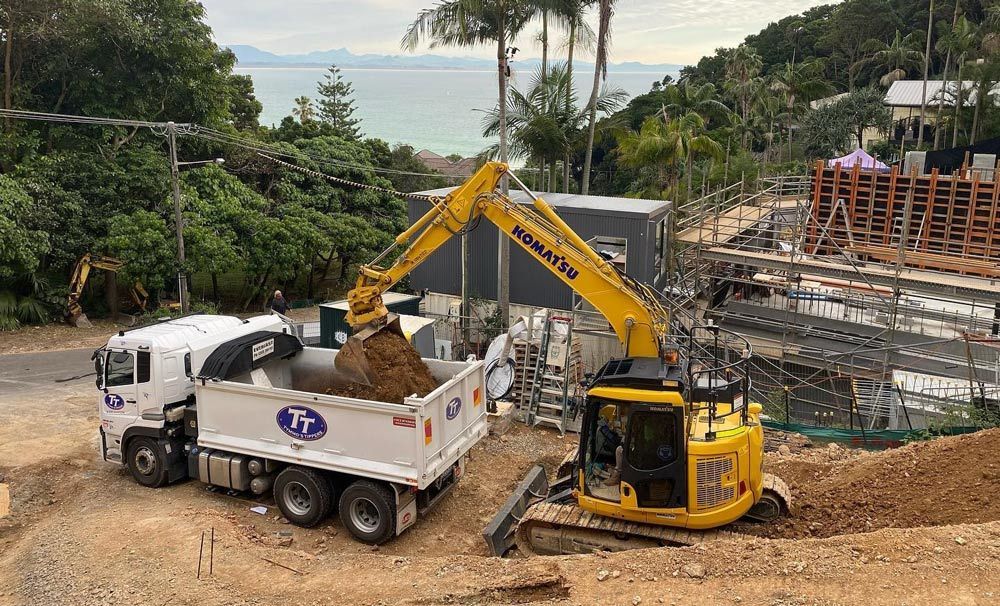
- Spoil removal is a cost that is sometimes underestimated at the planning stage. Excavated material needs to go somewhere, and on sites with acid sulfate soils or contamination, disposal options may be limited. For most residential projects, the excavated material is loaded directly into tippers and taken off-site to an approved facility. Coordinating
tipper truck hire Byron Bay alongside the excavator ensures the spoil removal keeps pace with excavation rather than causing delays when the site fills up.
- Timing matters more in Byron Bay than in many locations because of the wet season. The Byron Coast receives significant rainfall from late autumn through to early autumn, and site conditions in wet weather can make excavation more difficult, create erosion risk on cleared areas and complicate spoil management. Where scheduling allows, planning major earthworks for the drier months reduces these risks.
Why Choose Tymmo's for Excavator Hire in Byron Bay?
Tymmo's is a family-owned and operated earthmoving business based in the Northern Rivers, with a fleet of excavators ranging from 1.8T to 20T and tippers from 5T to 13T. As an Indigenous-owned business and Supply Nation member, we bring both the equipment and the local knowledge that Byron Bay and Northern Rivers projects require.
Our operators understand the site conditions common across the Byron Shire — the clay soils, the wet-weather challenges, the access constraints of established residential neighbourhoods and the care required around drainage and environmental features. We work with homeowners, owner-builders and small developers to match the right equipment to the job and to complete earthworks efficiently once approvals are in place. At Tymmo's, we provide excavator hire in Byron Bay locals and Northern Rivers property owners rely on for residential and civil earthworks. Call us on 0431 158 066 or visit our website to discuss your project and arrange a quote.